Leave Your Message
Picking a reliable Baby Warmer Bulk Supplier isn't just about comparing unit prices. If you're buying globally, you also need to look at safety, temperature control, documentation, and after-sales support.
The World Health Organization's 2022 recommendations for preterm and low-birth-weight infants put a lot of emphasis on safe thermal care and continuous monitoring. They don't endorse any one commercial brand. Still, they make it clear why temperature accuracy matters so much in neonatal settings. For clinical radiant warmers, buyers should check compliance with IEC 60601-2-21 and any applicable medical-device requirements. Consumer bottle warmers are a different story—you'll want to evaluate heating consistency, material safety, and electrical protection too.
Market research from Grand View Research and Fortune Business Insights points to continued growth in baby-care equipment. Exact market estimates don't always match between reports. And honestly, that gap deserves attention rather than blind confidence. Forecasts can shift with birth rates, hospital investment, and regional regulations.
This guide looks at ten suppliers serving international buyers. The selection weighs production experience, factory audits, certifications, customization, minimum order quantities, and export communication. Some focus on hospital-grade equipment. Others make household bottle warmers, feeding accessories, or related products.
A practical supplier should be able to provide clear test reports, serial-number traceability, multilingual manuals, and replacement-part plans. Ask for sample testing before you place a large order. A polished catalog alone isn't proof of dependable performance.
If you're sourcing adjacent products, you may also run into the phrase “thermos pot Supplier.” That's a separate category from infant warming equipment, so it shouldn't be judged by the same standards.
The strongest supplier isn't always the cheapest. Sometimes the lowest quotation creates the biggest long-term risk. This ranking is a useful starting point, but independent verification is still essential.
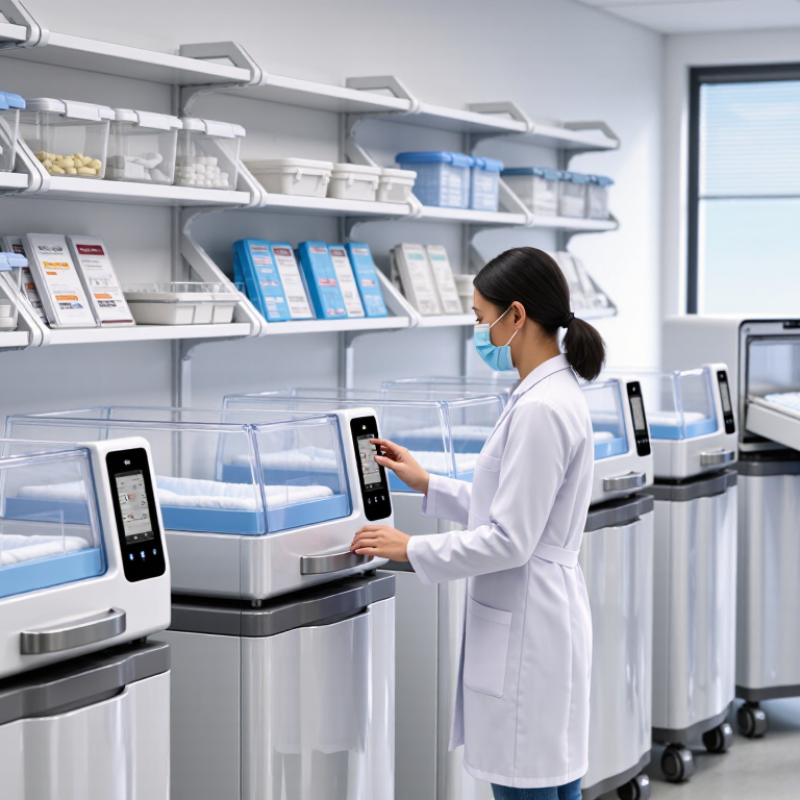
For global buyers, neonatal thermal care begins with one measurable target: 36.5–37.5°C. WHO guidance identifies this range as normal for newborns. A warmer should support stable temperatures, not simply produce intense heat. Servo control, a skin probe, visible alarms, and clear calibration records are essential. A bright display helps staff notice small changes beside a busy cot.
When comparing bulk suppliers, request temperature accuracy data under realistic room conditions. Ask how each unit behaves during power interruption, probe displacement, and cleaning. Check whether replacement probes and service training are available locally. Packaging also matters. Shock-resistant crates, moisture protection, and readable manuals reduce avoidable delays at the receiving facility. A supplier with strong documentation is often more dependable than one offering the lowest unit price.
Procurement teams should test samples before approving a large order. Place a calibrated thermometer beside the infant-contact area, then observe the warmer during startup and continuous operation. Small errors matter. A displayed 37.0°C may not reflect the exact mattress surface temperature. No checklist is perfect, and staff may use equipment differently than expected. That weakness should be discussed openly. Training records, maintenance intervals, and clear escalation procedures help turn a technically capable warmer into safer daily care. Bulk contracts should also define inspection standards, delivery timelines, warranty support, and spare-part availability before payment terms are finalized.
Anonymized bulk-sourcing benchmark for neonatal thermal-care equipment. Supplier names and brand data are intentionally omitted; rows represent supplier qualification profiles that buyers should verify through technical files, samples, audits, and regulatory documentation.
| Supplier Profile | Primary Product Scope | Thermal-Care Configuration | Target Patient-Space Temperature | Relevant IEC 60601 Particular Standard | Quality-System Evidence to Request | Bulk-Buying Strength | Critical Verification Point |
|---|---|---|---|---|---|---|---|
| Supplier Profile 01 |
Open infant radiant warmer Resuscitation-bed configuration |
Overhead radiant heat with skin-temperature feedback; open access for emergency care |
36.5–37.5°C clinical target Verify servo-control accuracy and alarm limits |
IEC 60601-2-21 for infant radiant warmers; IEC 60601-1; IEC 60601-1-2 | ISO 13485 certificate, risk-management file, electrical-safety test report, calibration records | High for labor wards, NICUs, and resuscitation areas | Confirm independent skin-probe failure alarm, overheating protection, and backup operating mode |
| Supplier Profile 02 |
Closed neonatal incubator Continuous-care configuration |
Air-temperature and skin-temperature control inside a closed, humidified chamber |
36.5–37.5°C clinical target Validate displayed versus measured temperature |
IEC 60601-2-19 for infant incubators; IEC 60601-1; IEC 60601-1-2 | ISO 13485, biocompatibility information for patient-contact parts, cleaning-validation data | High for neonatal intensive-care installations | Check humidity control, oxygen-access design, mattress dimensions, and serviceability of seals and filters |
| Supplier Profile 03 |
Transport incubator Ambulance and interfacility transfer |
Closed thermal enclosure with battery operation and transport mounting |
36.5–37.5°C clinical target Test stability during mains-to-battery transition |
IEC 60601-2-20 for transport incubators; IEC 60601-1; IEC 60601-1-12 where applicable | ISO 13485, battery and charger test records, vibration and transport validation, EMC documentation | High for regional referral networks and emergency transport fleets | Verify battery runtime under specified load, restraint compatibility, and operation during vehicle movement |
| Supplier Profile 04 |
Hybrid warmer Open and enclosed care modes |
Radiant warmer that converts to an enclosed or canopy-supported configuration |
36.5–37.5°C clinical target Assess both open-bed and enclosed-mode performance |
Applicable requirements from IEC 60601-2-19 and IEC 60601-2-21, depending on configuration | ISO 13485, configuration-specific test reports, software lifecycle documentation if digitally controlled | High where one device must support multiple care stages | Ensure every operating mode is covered by the regulatory submission and user manual |
| Supplier Profile 05 |
Radiant warmer with resuscitation module Integrated neonatal stabilization |
Radiant heat, adjustable mattress, integrated gas pathways, and resuscitation workspace |
36.5–37.5°C clinical target Measure thermal recovery after access and procedures |
IEC 60601-2-21; IEC 60601-1; applicable gas and resuscitation-system requirements | ISO 13485, gas-flow accuracy report, alarm verification, risk analysis for integrated accessories | High for delivery rooms and neonatal stabilization units | Check compatibility with local oxygen/air connectors, suction systems, and resuscitation protocols |
| Supplier Profile 06 |
Low-resource facility warmer Essential-function configuration |
Basic radiant heating with simple controls, robust frame, and low-maintenance design |
36.5–37.5°C clinical target Require documented control tolerance and alarm behavior |
IEC 60601-2-21; IEC 60601-1; IEC 60601-1-2 | ISO 13485 or equivalent documented quality system, production inspection plan, spare-parts list | High for decentralized hospitals and public-health tenders | Evaluate voltage tolerance, grounding, cleaning compatibility, and availability of local technical support |
| Supplier Profile 07 |
NICU premium warmer Networked clinical configuration |
Servo-controlled heating with digital alarms, weighing, trend display, and optional data connectivity |
36.5–37.5°C clinical target Verify sensor calibration and data accuracy |
IEC 60601-2-21 or IEC 60601-2-19 according to the device design; IEC 60601-1-2 | ISO 13485, software lifecycle file, cybersecurity documentation, electrical and EMC reports | High for tertiary hospitals with centralized monitoring | Confirm interoperability, access controls, software-update policy, and alarm integration |
| Supplier Profile 08 |
Phototherapy-compatible warmer Thermal and jaundice-care combination |
Radiant warmer integrated with or prepared for neonatal phototherapy equipment |
36.5–37.5°C clinical target Check heat contribution from phototherapy operation |
IEC 60601-2-21 for warmer; IEC 60601-2-50 for infant phototherapy equipment where applicable | ISO 13485, phototherapy irradiance report, thermal interaction testing, eye-protection instructions | Medium to high for units requiring space-efficient treatment | Verify irradiance uniformity, thermal rise, eye shielding, and whether accessories are included in certification |
| Supplier Profile 09 |
Modular hospital warmer Configurable accessories |
Base warmer with selectable shelves, drawers, scales, oxygen supports, and monitoring mounts |
36.5–37.5°C clinical target Test performance with all ordered accessories installed |
IEC 60601-2-21; IEC 60601-1; IEC 60601-1-2 | ISO 13485, accessory compatibility matrix, mechanical-load testing, configuration-control records | High for standardized multi-site hospital purchasing | Require a final configuration list so accessories do not invalidate testing or warranty coverage |
| Supplier Profile 10 |
Private-label capable supplier OEM/contract manufacturing |
Custom labeling, packaging, documentation, and selected hardware or software modifications |
36.5–37.5°C clinical target Buyer must verify the final customized version |
Applicable IEC 60601 standards depend on final device type and intended use | ISO 13485, design-transfer records, change-control procedure, regulatory-responsibility agreement | High for distributors purchasing repeat production batches | Clarify legal manufacturer, post-market obligations, technical-file ownership, and change-notification duties |
It should support a stable newborn temperature between 36.5°C and 37.5°C. Intense heat alone is not enough. Servo control and a skin probe help maintain this range.
Look for servo control, visible alarms, a bright display, and clear calibration records. The display should remain readable beside a busy cot. Probe displacement alarms also matter.
Place a calibrated thermometer beside the infant-contact area. Observe startup and continuous operation. Compare the display with the mattress surface temperature. Small errors matter.
Ask how the warmer behaves during a power interruption. Request written procedures and alarm details. Test recovery time when possible. Real rooms are rarely perfect.
A damaged probe can affect temperature control. Local replacement parts reduce waiting time. Service training helps staff respond correctly. Availability should be confirmed in writing.
Request temperature accuracy data, calibration records, electrical safety reports, and batch traceability. Ask for the exact model number on every document. A certificate alone is not enough.
Requirements depend on the destination and intended use. Buyers may need United States clearance, European medical-device documentation, and local registration. Check labeling, instructions, serial numbers, and product scope.
Compare production samples with the technical file. Check model numbers, labels, and test-report coverage. Some reports cover only one component. Keep written records of every answer.
Define inspection standards, delivery dates, warranty support, spare-part availability, and payment conditions. Include maintenance intervals and escalation procedures. Ambiguous terms cause avoidable delays.
No. Staff may use equipment differently than expected. No checklist is perfect. Independent review and practical testing can reveal uncomfortable gaps. That weakness deserves open discussion.
Choosing the right Baby Warmer Bulk Supplier requires more than comparing unit prices. This guide explains the WHO-recommended neonatal temperature range of 36.5–37.5°C and compares open-care, transport, and radiant warmers according to clinical use, temperature stability, and operational flexibility. It also highlights the importance of IEC 60601-1, IEC 60601-2-21, and ISO 13485 compliance when evaluating product safety and manufacturing quality.
For global buyers, supplier screening should cover MOQ, production capacity, lead time, warranty terms, service support, and export experience. The comparison framework considers warmer accuracy of approximately ±0.5°C, model suitability, and regional delivery coverage, while verification focuses on FDA 510(k), EU MDR, CE marking, and local registration requirements where applicable. A practical buyer scorecard can then balance unit cost, safety functions, technical support, spare parts, shipping, customs, and other total landed costs to support a reliable and informed purchasing decision.