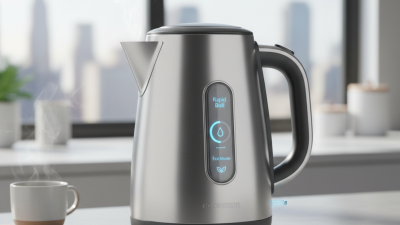
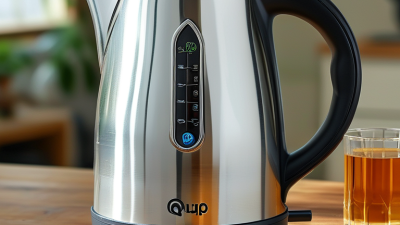
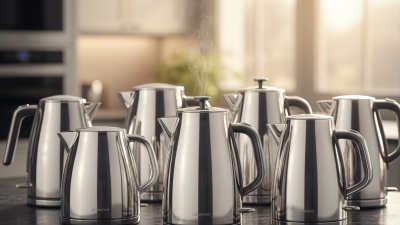
China's electric appliance market has really become a go-to for global buyers looking for reliable sources. Their electric kettles, in particular, stand out because of their competitive prices, a wide variety of designs, and improved temperature controls that you can actually depend on. But, honestly, just because a factory is big doesn’t always mean they’re the right partner for you.
In this guide, I want to introduce you to ten top Chinese electric kettle manufacturers—names like Midea, Supor, Joyoung, Xiaomi, Bear, Galanz, Haier, Donlim, Deerma, and Morphy Richards China. Each company has its own strengths, whether it’s faster heating, better stainless steel quality, cordless bases, smart features, or options for private labeling. Think about it—what works for a hotel kettle probably isn’t the same as what a family needs with temperature presets.
You know, appliance designer and product consultant James Dyson once said, “Good design is about making technology disappear.” That’s pretty spot-on when you're checking out electric kettles. It's a good idea to pay attention to small but crucial details—things like how easy it is to open and close the lid, water level markings, cable storage, and whether the automatic shut-off actually works well. Those tiny flaws might seem minor but can turn into bigger issues after thousands of cycles.
And let’s not forget, comparing options shouldn’t just be based on fancy catalogs and marketing claims. It’s important to look at the factory’s experience, whether they’ve got the right certifications, their quality control processes, how much they can produce, and how transparent they are during sampling. Sometimes, a factory might look good in photos but fail in real-world testing. Plus, the cheapest quote isn’t always the best deal—value counts.
This guide is meant for anyone involved in distributing, retailing, or managing private-label brands—whether you're in hospitality or general retail. It breaks down what each manufacturer can offer and points out where you might want to be cautious. Keep in mind, rankings can be pretty subjective—market conditions shift, and factory performance can differ from one product line to another. So, always double-check current certifications, test samples thoroughly, understand the warranty, and consider their exporting experience before sealing the deal. At the end of the day, you want a supplier who’s consistent—not just one that offers a tempting price upfront.
Electric Kettle Market Baseline: 2024 Demand Data and HS 8516.79
China Top 10 Electric Kettle Manufacturers for Global Buyers
Electric Kettle Market Baseline: 2024 Demand Data and HS 8516.79
In 2024, demand for Electric Tea Kettles stayed strong across homes, offices, hotels, and small food-service sites. Buyers increasingly requested cordless designs, rapid boiling, temperature control, and lower standby consumption. Customs records commonly place electric kettles under HS 8516.79, covering other domestic electro-thermic appliances. However, classification can differ by country and product structure.
This code is a useful starting point, not perfect proof. It may include appliances beyond kettles, so import totals need careful reading. Experienced sourcing teams compare customs values, shipment quantities, retail prices, and seasonal changes. A sudden rise in value may reflect higher specifications, not higher unit demand. That distinction matters when comparing Chinese suppliers.
Tips: Ask each manufacturer for its proposed HS code, test reports, rated voltage, plug type, and carton dimensions. Request recent production photos. Check whether the factory can repeat boil-cycle testing at scale. Stainless steel walls, clear water-level marks, and stable lids matter in daily use. One limitation remains: public trade data rarely separates every kettle model. Treat broad market figures as directional, then confirm them with purchase samples and buyer feedback.
China Top 10 Electric Kettle Manufacturers for Global Buyers
Electric Kettle Market Baseline: 2024 Demand Data and HS 8516.79
The chart presents a rounded 2024 regional demand baseline for electric kettles. Asia-Pacific and Europe represent the largest demand pools, while HS 8516.79 is used as the relevant customs classification for other electro-thermic appliances, including many electric kettles. Market shares are indicative estimates compiled from publicly available 2024 industry market assessments and may vary by product scope and research methodology.
China Supplier Map: Factory Clusters, Capacity Signals, and CCC Status
China Top 10 Electric Kettle Manufacturers for Global Buyers
China’s electric kettle supply base is concentrated in several manufacturing clusters. Guangdong often offers mature export services, appliance assembly, and packaging support. Zhejiang is known for metal forming, plastic injection, and efficient small-appliance production. Jiangsu also provides strong engineering resources and organized industrial parks. These locations are useful starting points, not automatic quality guarantees.
A supplier map should include more than city names. During factory checks, I look for molding machines, assembly lines, aging-test areas, and spare-part storage. Capacity signals include monthly output, shift patterns, equipment ownership, and recent production records. A large showroom can mislead. Request dated production photos, line videos, and anonymized inspection reports. Some suppliers provide impressive figures without explaining seasonal capacity. That gap deserves questions.
Tips: Confirm whether the kettle model falls within China’s current CCC certification scope. Ask for the certificate number, model coverage, issuing authority, and validity status. Verify the record through an official channel, not only a scanned document. Check whether the certificate matches the factory and exact product specification. Also review electrical safety testing, temperature control, leakage protection, and food-contact materials. Small details matter. My own audits are not perfect; production conditions can change after approval. Schedule pre-shipment inspections and keep written acceptance standards. This creates stronger evidence for reliable global purchasing.
How the Top 10 Were Ranked: Export, Certifications, MOQ, and OEM Data
China Top 10 Electric Kettle Manufacturers for Global Buyers
How the Top 10 Were Ranked: Export, Certifications, MOQ, and OEM Data
This ranking uses practical supplier evidence, not showroom claims. We reviewed export experience, factory capacity, product documentation, and buyer support. Shipment records helped indicate whether manufacturers regularly serve overseas markets. A single large order was not treated as proof.
Certifications formed another key measure. We checked valid safety reports, quality systems, and test documents for current electric kettle models. Documents must match the factory, product rating, and production location. Expired files reduce confidence. Small details matter, such as plug standards, cable markings, and heat-resistant material records.
Minimum order quantity was compared against realistic buying needs. Flexible MOQs can help importers test kettle kettles before committing to full containers. We also examined OEM performance through sample development, logo placement, packaging design, and mold support. Clear timelines showed stronger project control. Factory audits, response speed, and replacement procedures added practical weight.
The method still has limits. Export data may not reveal every private transaction. Certification checks can also miss a document updated last week. Some manufacturers communicate well but provide weak after-sales evidence. That is why the ranking should be reviewed before each purchase. Product samples, factory video calls, and independent testing remain necessary. No spreadsheet can replace handling a boiling kettle.
Top 10 Manufacturer Profiles: Product Range, Output, and Target Markets
China’s top ten electric kettle manufacturers serve very different purchasing needs. Their product ranges include stainless steel kettles, glass models, travel units, temperature-control kettles, and kettles and water heaters for commercial use. Several factories also produce cordless bases, spare lids, filters, and private-label packaging.
Output varies widely across these manufacturer profiles. Smaller facilities may produce 20,000 to 50,000 units monthly, while larger plants can exceed 300,000 units during peak seasons. Buyers should inspect molding lines, heating-element assembly, leak testing, and final inspection records. A clean production floor matters. So does traceability.
Target markets shape each supplier’s design choices. European-focused factories often emphasize quiet boiling, repairable parts, and energy performance. Middle Eastern buyers may request larger capacities and stronger heat resistance. Southeast Asian distributors commonly seek compact models for apartments and hotels. Export experience is useful, but it does not guarantee consistent quality. Production figures can be self-reported, and some catalogs show discontinued models. Independent sample testing remains necessary. I would also compare batch records, warranty handling, and packaging strength before signing a large order. Some manufacturers look impressive online, yet their after-sales systems need closer questioning.
Technical Benchmark: 1.0–1.7 L, 1,500–3,000 W, and IEC 60335-2-15
China Top 10 Electric Kettle Manufacturers for Global Buyers
For electric kettle electric sourcing, the practical benchmark starts with capacity and power. Market reports from Grand View Research and Mordor Intelligence show continued growth in household beverage appliances, driven by convenience and faster heating. Most export models sit between 1.0 and 1.7 liters. A 1.5-liter kettle at 2,000 watts can boil a full load in roughly four to five minutes, depending on water temperature and voltage. Higher power shortens waiting time, but it also increases plug, cable, and thermal-control demands.
IEC 60335-2-15 covers safety requirements for appliances heating liquids. It is used with IEC 60335-1, not as a standalone approval. Buyers should request test reports matching the final model, rated voltage, plug, and materials. Check dry-boil protection, automatic shutoff, steam-path design, leakage current, and cord anchorage. A 3,000-watt model may suit 220–240 V markets, while it can be unsuitable for lower-voltage systems. That detail is often missed. Product listings are not evidence of compliance.
Tips: Ask for a heating-time test at 20°C, a repeated boil-cycle test, and a sample inspection before mass production. Compare usable capacity, not only the advertised volume. Also check whether the 1.7-liter mark leaves safe expansion space.
One weakness remains: factory data may use ideal laboratory water and voltage. Independent verification is safer, especially when sourcing ten leading manufacturers across different production regions.
Global Buyer Due Diligence: Testing, Incoterms, Lead Times, and Defect Rates
For global buyers comparing China’s top 10 electric kettle manufacturers, due diligence should begin on the factory floor, not in a catalog. Request recent test reports covering leakage, insulation, grounding, boil-dry protection, temperature control, and food-contact materials. Ask which laboratory performed each test and whether samples came from normal production. A polished sample proves little. Production consistency matters more.
Confirm the inspection plan before placing an order. A pre-production review can check components, while a final inspection should measure wattage, switch life, water leakage, packaging strength, and random appearance defects. Keep signed photos and serial numbers. Defect rates need a clear formula. One factory may count only returned units; another may count every failed inspection. Compare the same denominator, such as defects per 1,000 units. Small differences become expensive at scale.
Incoterms must match your actual logistics control. Under FOB, verify port responsibility and export documentation. Under DDP, clarify taxes, customs handling, and delivery exceptions in writing. Lead times should separate tooling, sample approval, production, testing, and shipping. Request a weekly schedule with recovery actions for delays. I have seen buyers accept “25 days” without defining the start date. That wording invites disputes. A stronger contract states tolerance, replacement rules, and payment triggers. Even then, forecasting remains imperfect; seasonal demand and component shortages can still expose weak planning.
Compliance Checklist: GB 4706.19, CE, CB, RoHS, and HS 8516.79
China Top 10 Electric Kettle Manufacturers for Global Buyers
Compliance Checklist: GB 4706.19, CE, CB, RoHS, and HS 8516.79
Global buyers should treat compliance as a verification process, not a supplier promise. Grand View Research’s 2024 study estimates the electric kettle market will continue growing at about 5% annually. That growth increases scrutiny on safety, materials, and customs data. For China-made kettles, GB 4706.19 addresses appliance safety requirements, including heating elements, insulation, abnormal operation, and leakage current. Buyers should request current test reports, production samples, wiring diagrams, and factory quality records.
CE compliance requires the correct EU legislation, technical documentation, risk assessment, and declaration of conformity. It is not simply a laboratory sticker. CB certification can support acceptance across participating national certification systems, but destination-country rules still matter. RoHS documentation should confirm restricted-substance controls in plastics, solder, cables, and circuit boards. Ask for material declarations, not only a generic certificate.
HS 8516.79 is commonly used for other domestic electrothermic appliances, including some electric kettles. Classification can change with product design and customs interpretation. UN Comtrade data shows substantial international trade under this wider category, but the code does not prove product compliance. A reasonable checklist also includes temperature tests, dry-boil protection, plug compatibility, markings, and traceable serial numbers. Certificates can expire. Samples can differ from mass production. That uncomfortable gap deserves another inspection.
China Top 10 Electric Kettle Manufacturers for Global Buyers - Compliance Checklist: GB 4706.19, CE, CB, RoHS, and HS 8516.79
Manufacturer-Screening and Product-Compliance Data Checklist for International Electric Kettle Sourcing
| No. |
Compliance or Data Dimension |
Factual Requirement for Electric Kettles |
Recommended Buyer Evidence |
Buyer Check |
| 1 |
China product-safety standard |
Confirm evaluation against GB 4706.1, the general safety standard for household and similar electrical appliances, together with GB 4706.19, the particular requirements applicable to electric water boilers and kettles.
|
Current laboratory test report identifying the exact model, rated voltage, rated frequency, power input, construction, and applicable Chinese standards.
|
Required for China |
| 2 |
GB 4706.19 technical scope |
Verify safety functions relevant to kettles, including protection against electric shock, abnormal operation, temperature rise, leakage current, moisture resistance, mechanical strength, and abnormal heat or fire risk.
|
Detailed test report with clause-by-clause results, photographs of tested samples, and confirmation that the tested sample matches the production design.
|
Model-specific |
| 3 |
CE electrical safety |
For products placed on applicable European Union markets, assess the Low Voltage Directive 2014/35/EU when the product falls within its voltage range and prepare an EU Declaration of Conformity.
|
EU Declaration of Conformity, technical file, risk assessment, product specifications, and applicable electrical-safety test reports.
|
EU market |
| 4 |
CE electromagnetic compatibility |
Evaluate applicable requirements under the EMC Directive 2014/30/EU, particularly where the kettle contains electronic controls, digital displays, touch controls, wireless functions, or switching circuitry.
|
EMC test report covering emissions and immunity appropriate to the product configuration, plus inclusion in the EU Declaration of Conformity where applicable.
|
Check electronics |
| 5 |
CE marking and technical file |
The CE mark must be supported by conformity documentation and must not be treated as a standalone quality certificate. The responsible economic operator and product traceability information should be defined for the target market.
|
Artwork showing CE placement, model and batch identification, importer or responsible-person details where required, and the signed Declaration of Conformity.
|
Document review |
| 6 |
CB Scheme safety certification |
Request an applicable IEC 60335-1 and IEC 60335-2-15 assessment for household electric heating appliances, including relevant national deviations when certification is intended for multiple countries.
|
Valid CB Test Certificate and CB Test Report showing the exact model, ratings, construction details, critical components, and certification body information.
|
Global sourcing |
| 7 |
RoHS substance restriction |
For applicable European Union products, confirm compliance with Directive 2011/65/EU and the amendment adding restricted phthalates under Commission Delegated Directive (EU) 2015/863.
|
RoHS declaration, material declarations, supplier declarations for critical parts, and risk-based laboratory screening such as XRF or chemical analysis where appropriate.
|
Material control |
| 8 |
Food-contact materials |
Water-contact components, such as the inner vessel, lid, seals, filter, and applicable coatings, should meet the food-contact requirements of the destination market. Requirements vary by jurisdiction and material type.
|
Material specifications, migration or extraction test reports, declarations of compliance, and identification of polymers, metals, elastomers, coatings, and adhesives in contact with water.
|
Destination-specific |
| 9 |
Electrical ratings and market configuration |
Confirm rated voltage, frequency, power input, plug type, cord construction, grounding or double-insulation design, automatic shut-off, boil-dry protection, and compatibility with the destination country's electrical system.
|
Approved product specification, nameplate artwork, wiring diagram, critical-component list, inspection records, and sample verification under the target market's voltage and frequency.
|
Pre-shipment check |
| 10 |
HS customs classification |
HS 8516.79 generally covers other electro-thermic appliances of a kind used for domestic purposes. The final tariff classification, duty rate, and any national statistical suffix must be confirmed with the importing country's customs authority or broker.
|
Commercial invoice, packing list, product description, technical specification, customs ruling or broker confirmation, and destination-country tariff-line verification.
|
Confirm locally |
Buyer note: Compliance results are product- and market-specific. Test reports should identify the exact model and production configuration; certificates for similar products or different electrical ratings should not be assumed to cover the purchased model.
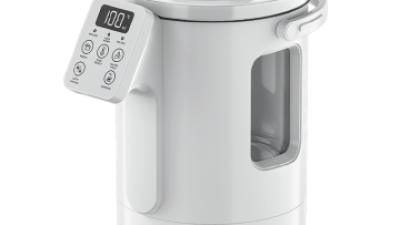
Precision Temperature Control Thermo Pots for Better Tea and Coffee: Features, Benefits, and Buying Guide
Precision temperature control thermo pots make preparing tea and coffee more consistent, convenient, and enjoyable. Instead of relying on guesswork, users can select a suitable temperature for different beverages, helping preserve delicate tea flavors while supporting the ideal extraction of coffee. Precise water dispensing also allows better control over pouring speed and volume, making it useful for individual cups, shared servings, and pour-over brewing. Fast heating reduces waiting time, while an easy-to-clean interior helps maintain freshness between uses.
When choosing an electric thermo pot, consider adjustable temperature settings, clear controls, and a capacity that matches your household or office needs. A well-designed model should include reliable auto shut-off and overheating protection for safer daily operation. Look for a smooth, accessible opening and a simple dispensing mechanism that minimizes spills and makes refilling straightforward. Manufactured in a modern factory, this premium kettle combines efficient heating with practical temperature management, offering a space-saving solution for kitchens, work areas, and tea stations. Its convenient design supports repeated brewing throughout the day without adding unnecessary complexity.
FAQS
The review examined export records, factory capacity, certifications, MOQ flexibility, OEM support, and buyer service. A single large shipment was not enough. Evidence mattered more than showroom claims.
Regular overseas shipments suggest practical experience with customs, packaging, plugs, and destination requirements. Private transactions may remain invisible. So export data is useful, but incomplete.
Request current safety reports, quality records, conformity documents, and restricted-substance declarations. Documents must match the factory and kettle model. Expired certificates reduce confidence.
The relevant appliance safety standard covers heating elements, insulation, leakage current, and abnormal operation. Ask for test reports and wiring diagrams. Small details matter.
No. Buyers should review technical files, risk assessments, and declarations of conformity. The marking alone is not enough. Check the destination country’s rules.
RoHS records should address plastics, solder, cables, and circuit boards. Ask for material declarations, not only a general certificate. The paperwork can be vague.
A lower or flexible MOQ allows sample market testing before a full-container purchase. Buyers can inspect several units first. That reduces early risk.
Confirm sample development, logo placement, packaging artwork, mold support, timelines, and replacement procedures. Request approval samples before mass production. Details sometimes drift.
No. A classification code helps customs describe the product, but it does not prove safety or conformity. The final code may depend on design and customs interpretation. Check locally.
Review samples, arrange a factory video call, verify documents, and consider independent testing. Compare samples with mass-production records. No spreadsheet replaces handling a boiling kettle.
Conclusion
This guide provides global buyers with a practical overview of China’s Electric Kettles manufacturing sector, including 2024 market demand, HS 8516.79 classification, major production clusters, capacity indicators, and CCC requirements. It explains how leading manufacturers can be evaluated through export experience, certifications, minimum order quantities, OEM capabilities, product range, production output, and target markets, without relying solely on promotional claims.
The article also compares common technical specifications, including 1.0–1.7-liter capacities, 1,500–3,000-watt power ratings, and IEC 60335-2-15 safety considerations. Buyers receive a structured due-diligence checklist covering factory audits, product testing, Incoterms, lead times, quality controls, and defect-rate reporting. Finally, it outlines key compliance areas such as GB 4706.19, CE, CB, RoHS, and accurate HS 8516.79 classification, helping importers make informed sourcing decisions and reduce operational and compliance risks.