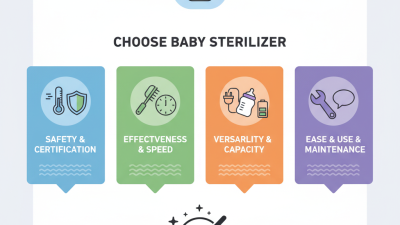
Picking a Uvc Bottle Sterilizer isn’t just about price tags. You’ve got to think about how you’ll actually use it, how much room it has inside, how long a cycle takes, what materials it’s made of, and what the instructions say. That stuff matters a lot when you’re dealing with narrow-neck bottles, silicone bits, or parts that come apart. A pretty product photo only tells you so much—it can’t answer all the practical questions. Yep, real specifications can—no doubt about it.
Alright, so this guide is all about Chinese manufacturers in the bottle sterilizer market—and what you should really look into before reaching out to them. It walks you through product range, manufacturing experience, quality documentation, customization options, and after-sales communication. These are solid starting points for narrowing down your shortlist, but they don't necessarily mean every model performs the same. So don't be shy: ask for model-specific test data, clear manuals, and consistent product details. Don’t just take things at face value—go ahead and verify claims yourself.
Look, some suppliers stick to compact countertop units for home use. Others go bigger, or do OEM work for brands you’ve probably heard of. The thing is, capabilities vary a lot, and public info only tells you so much—that gap is worth paying attention to. Rankings shift too, as product lines, factories, and service standards evolve. So treat this less like a definitive list and more like a starting point. When you’re choosing, dig into the actual model, verify who’s really making it, and think about how it fits your bottles and your daily routine. It’s the little details that end up mattering.
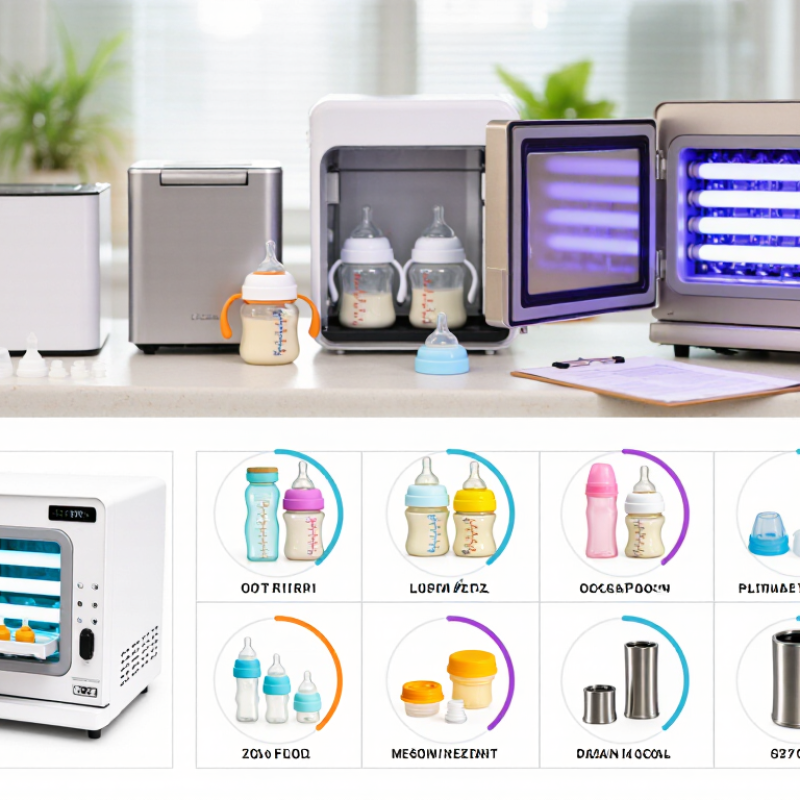
A Uvc Sterilizer uses short-wave ultraviolet light to reduce microorganisms on exposed bottle surfaces. The light can damage microbial genetic material, preventing many organisms from reproducing. Performance depends on the device’s wavelength, exposure time, and delivered dose. A short cycle is not automatically an effective one.
Light needs a path. Bottle necks, deep interiors, and overlapping parts can create shadows, where UVC reaches poorly. Clean bottles first, then separate removable nipples, rings, and caps as the manufacturer directs. Residue can block exposure. That matters. I would not treat an indicator light or a completed timer as proof that every surface received enough UVC; test data and clear use instructions are more useful.
A well-designed unit should keep UVC contained, with a lid or safety interlock that stops exposure when opened. Never look directly at an operating UVC source or expose skin to it. For daily use, check that bottles fit without blocking one another and that the cycle suits their materials. The word “sterilizer” can sound absolute, but results vary with setup and maintenance. That distinction deserves attention.
When comparing UVC bottle sterilizer manufacturers in China, look beyond product photos and quoted output. Ask how the unit’s UVC intensity and exposure time were measured. A useful test should reflect the bottle’s shape, interior, and cap—not just an exposed flat surface. Shadows can limit light exposure, so request test conditions and results for realistic bottle configurations. Ask for proof.
Review the manufacturer’s quality controls, too. Check whether incoming components are inspected and whether finished units receive consistent functional testing. Useful records may include lamp or LED performance checks, cycle verification, and electrical safety assessments. Ask how production batches are traced and how failures are handled. Clear answers matter. Be cautious of broad claims that lack test details. Even a careful review has limits; I would verify results using the exact bottle model and operating cycle intended for use.
Tips: Request a sample unit and its test report before committing to a large order. Compare the report’s test setup with your own use case. Also confirm material compatibility, cleaning instructions, warranty terms, production capacity, and lead times in writing. Small gaps in documentation can become costly later. Keep questions specific, and note where the supplier’s answers remain uncertain.
Leading UVC bottle sterilizer manufacturers in China combine optical design, electronics, and practical product testing. Buyers should ask how the chamber limits light leakage and how exposure is checked across bottle shapes. A reflective interior can help distribute UVC, but narrow necks and deep bottle bases may still create shaded areas. That detail matters.
Experienced manufacturers can explain their test setup, including sensor placement, cycle duration, and the bottle materials used during evaluation. Ask for test reports that identify the measured conditions, rather than relying on a simple “sterilizing” claim. UVC performance depends on distance, surface exposure, and clean bottle interiors. Results may differ in everyday use. A careful supplier will say so.
Production capabilities also deserve close review. Request details about incoming component checks, batch records, electrical safety testing, and how faults are handled after shipment. For a sample unit, inspect the lid interlock, cycle indicator, ventilation, and finish around seams. Small gaps can be easy to miss. Chinese manufacturers vary in engineering depth, even when their product photos look similar. I would not judge capability from a polished catalog alone; a documented test and a clear technical conversation offer better evidence.
Top UVC Bottle Sterilizer Manufacturers in China: Comparing Product Designs, Features, and Applications
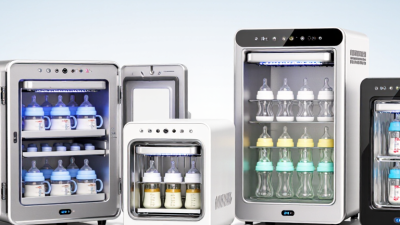
UVC bottle sterilizers from Chinese manufacturers vary in shape, capacity, and intended use. Compact models often resemble a travel mug, with a screw-on lid and a small rechargeable battery. Larger countertop units can hold several bottles, pump parts, or pacifiers. The fit matters. A narrow chamber may leave bottle shoulders or accessories poorly exposed.
Product features deserve close inspection. Buyers searching for Sterilize Uvc bottle systems should check wavelength specifications, safety interlocks, cycle length, and charging options. UVC light works only where it reaches; shadows, residue, and bottle geometry can reduce exposure. A clear cycle indicator is useful, but it does not prove performance by itself. Ask manufacturers for test methods and independent validation, not just a headline claim.
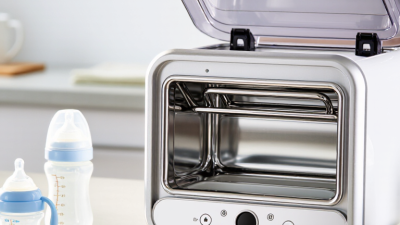
Applications differ, too. A lightweight unit may suit travel or a small nursery, while a larger chamber works better for routine household batches. Stainless-steel interiors can be easier to wipe than textured surfaces, though hinges and seals still collect grime. Real use can be less tidy than product photos suggest. Consider replacement parts, battery life, and cleaning instructions before comparing prices.
Typical nominal wavelengths for common UVC source types; values are in nanometers (nm).
Low-pressure mercury lamps commonly emit at 254 nm, while UVC LEDs are available around 265 nm and 275 nm. All are within the UVC band (100–280 nm). Disinfection performance also depends on delivered dose, exposure time, and how evenly light reaches the bottle’s interior.
For buyers comparing Top UVC Bottle Sterilizer Manufacturers in China, quality checks should go beyond product claims. Ask for an ISO 9001 quality-management certificate and recent, model-specific test reports. The CIE’s 2020 position statement defines UV-C as wavelengths from 100 to 280 nanometres and warns that exposure can harm eyes and skin. A polished brochure is not proof of safe design.
Review electrical safety documentation, such as testing against applicable IEC 60335 requirements, and photobiological risk assessments based on IEC 62471. Requirements vary by destination market, so confirm that certificates cover the exact model and factory. For Uvc Sterilization performance, request test conditions: wavelength, measured dose, bottle position, water or surface conditions, and exposure time. Results from an empty test chamber may not reflect a narrow bottle’s shaded interior. That gap deserves attention.
Tips: Request the full lab report, not just a certificate image. Check report dates, sample identifiers, and test-lab accreditation. Compare claims carefully; “sterilizes” can sound more certain than the evidence supports.
| Evaluation Dimension | Standard or Requirement to Consider | Evidence to Request from the Manufacturer | What a Strong Evaluation Looks Like |
|---|---|---|---|
| Electrical safety | IEC 60335-1, where applicable, together with the relevant product-specific safety standard for the appliance’s design and intended use. | Test report identifying the exact model, test configuration, applicable standard and edition, and issuing laboratory. | The report covers the finished bottle sterilizer—not merely a UV-C module—and addresses electrical, thermal, mechanical, and abnormal-operation risks. |
| UV-C eye and skin exposure | IEC 62471, or another applicable photobiological safety assessment for the product and its UV source. | Photobiological safety report, leakage measurements, and details of testing conditions and measurement locations. | The assessment considers accessible UV-C radiation during normal use and reasonably foreseeable misuse, including operation with the lid open where relevant. |
| UV-C exposure control | Risk controls appropriate to the product, such as a lid interlock, automatic shutoff, shielding, and clear operating instructions. | Interlock test records, design documentation, and verification results for relevant fault or misuse conditions. | Protective controls are built into the product and verified; warnings are not used as the sole safeguard against UV-C exposure. |
| Disinfection performance | A documented, reproducible test method using relevant test organisms and representative product-use conditions. | Full performance report stating organisms, inoculation and recovery methods, test locations, cycle time, sample count, controls, and results. | Results are tied to the tested model and defined operating conditions. Marketing claims such as “99.9%” are supported by a report rather than a certificate alone. |
| UV-C source and dose consistency | Verification of the UV-C source’s wavelength, output, placement, and performance over the specified operating cycle. | Component specifications and measurement records, plus a method for checking output or dose consistency during production. | Testing accounts for relevant shadowing and bottle geometry; the manufacturer explains how production variation and source aging are controlled. |
| Electromagnetic compatibility | Applicable EMC requirements for the destination market; CISPR 14-1 and CISPR 14-2 may be relevant to household appliances, depending on product scope. | EMC test reports for emissions and immunity, with the tested model and configuration clearly identified. | Reports match the finished product and target market. The manufacturer can identify which EMC requirements apply rather than presenting an unrelated test report. |
| Materials and restricted substances | Destination-market chemical requirements, such as EU RoHS Directive 2011/65/EU as amended, where applicable. | Material declarations, supplier declarations, and test reports for relevant components or homogeneous materials. | Documentation covers the actual bill of materials and is kept current when components or suppliers change. |
| Quality management system | ISO 9001 certification can provide evidence of a quality management system; it does not by itself certify product safety or disinfection performance. | Current certificate showing the legal entity, certified site, scope, certification body, and validity dates. | The certified scope and site correspond to the organization and manufacturing activities responsible for the product. |
| Factory production controls | Documented incoming inspection, in-process checks, final testing, traceability, and corrective-action procedures. | Quality plan, sample inspection records, lot-traceability examples, and records showing how nonconforming products are handled. | Controls cover critical items such as the UV-C source, interlock, power supply, cycle function, and finished-product inspection. |
| Market-specific conformity | Applicable conformity requirements depend on the destination and product classification. For the EU, the manufacturer should identify applicable legislation and maintain the required technical documentation. | Declaration of Conformity where required, supporting test reports, product labeling, and instructions for the intended market. | Claims are supported by applicable documentation. A CE mark is a conformity marking, not by itself proof of independent third-party testing. |
| Certification and report verification | Verification of the issuer, document scope, model number, standard edition, and validity or status of each certificate or report. | Complete documents with report numbers and issuing-body details; permission to confirm authenticity with the issuer when necessary. | Documents refer to the offered model and factory, and the manufacturer distinguishes product test reports from factory-system certificates. |
| Change management and after-sales quality | Controlled engineering changes, complaint handling, corrective actions, and spare-parts support. | Change-control procedure, complaint process, warranty terms, and a sample record showing product or component traceability. | Changes to UV-C components, electronics, materials, or production sites trigger appropriate review and retesting where needed. |
Note: Applicable standards and legal requirements depend on the product’s design and sales market. Ask the manufacturer to confirm applicability for the exact model and verify certificates and test reports with their issuing organizations.
Choosing a UVC bottle sterilizer manufacturer in China takes more than comparing prices. Ask whether the supplier designs the product or mainly assembles purchased parts. Request a component list, product specifications, and clear details about testing. Check how the unit handles door openings, timer settings, and uneven bottle placement. These details affect everyday use. A polished sample can still hide production inconsistencies.
Tips: Request a sample and test it with the bottle shapes you actually use. Ask for recent inspection records, packaging dimensions, and written warranty terms. Confirm who handles replacement parts.
Before placing a larger order, agree on measurable quality checks, such as casing fit, control response, and visible damage. Ask how the factory tracks changes to components between sample approval and production. Keep specifications and approved samples documented. Communication matters, too: slow or vague answers during quotation may lead to confusion later. Still, paperwork is not proof of consistent output. Consider a small trial order, then inspect units from different cartons. A dependable partner should explain limitations plainly, including what its tests do not verify.
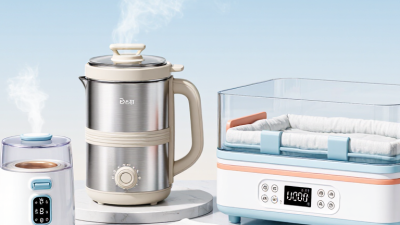
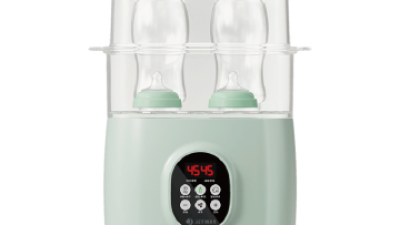
For parents comparing a China baby bottle sterilizer electric steam dryer, dependable hygiene and everyday ease matter most. This model uses 100°C high-temperature steam sterilization to eliminate up to 99.99% of germs, helping keep bottles and feeding accessories clean between uses. Its 360° all-round drying helps reduce leftover moisture, while the 45°C constant-temperature warming function gently warms milk when needed. Together, these features make it a practical choice for busy households seeking a reliable routine for baby care.
The 6.5 cm wide opening accommodates a range of essentials, including wider bottles, breast pumps, pacifiers, and small utensils. A simple one-touch screen makes operation straightforward, even during a hectic day. When choosing a sterilizer, parents should check that items are suitable for steam sterilization, arrange them according to the instructions, and allow the unit to cool before handling its contents. Made by a China-based supplier with a modern factory, this electric sterilizer and dryer combines useful capacity, accessible controls, and multiple care functions for new parents.
Compare chamber size, cycle length, charging options, and safety features. A narrow chamber may not expose bottle shoulders evenly.
No. It shows cycle status, not necessarily UVC exposure or performance. Ask for test methods and independent validation.
A compact, rechargeable unit may fit travel and small spaces. A countertop chamber can hold several bottles or accessories at once.
Yes. Shadows, residue, and bottle geometry can block light. Test the unit with the bottle shapes you actually use.
Request specifications, a component list, inspection records, and written warranty terms. Ask who handles replacement parts.
Check casing fit, controls, door operation, and bottle placement. Small details matter.
Agree on measurable quality checks and document the approved sample. Inspect units from different cartons in a small trial order.
No. They may be easier to wipe, but hinges and seals can still collect grime. Cleaning instructions matter.
This article introduces the Uvc Bottle Sterilizer and explains how ultraviolet-C light is used to reduce microorganisms on bottle surfaces when products are operated as directed. It outlines practical criteria for evaluating Chinese manufacturers, including production capabilities, design experience, customization options, communication, and quality-control processes. Rather than focusing on brand names, it offers a general framework for comparing suppliers and understanding the range of products available.
The article also compares designs, features, and intended applications, helping readers consider factors such as capacity, usability, safety features, and compatibility with their needs. It highlights the value of checking relevant quality standards, test documentation, and certifications, while encouraging buyers to confirm what applies to a specific product and destination. Finally, it provides guidance on sourcing a suitable manufacturer by clarifying requirements, requesting samples and specifications, assessing production consistency, and agreeing on clear terms before placing an order.